Free Deodorant Samples: How to Find Them and Read the Terms
Learn how to find free deodorant samples, check shipping and eligibility, and understand review terms before you accept any offer.
In this guide
- What Free Really Means for Deodorant Samples
- How to Find and Apply for a Sample, Step by Step
- Who Qualifies and How Brands Pick Testers
- Shipping, Timelines and What Happens If an Offer Closes
- Disclosure, Honesty and Keeping the Product
- Testing Deodorant Samples Safely on Your Skin
- Three Sample Scenarios and What Each Teaches
- Confirm the Terms and Join the Waitlist
Which part of a free deodorant sample is free?
Usually the stick itself, and nothing else. Postage, a card on file, a purchase that activates the offer, and the review you're expected to write are separate line items, and each one can turn a giveaway into a commitment.
That matters more in deodorant than in most categories. U.S. supermarket deodorant unit sales reached approximately 837.16 million units in July 2025, compared with 782.6 million units in 2024, a rise of about 7.0% year over year, according to market data summarized by Mordor Intelligence. Statista's outlook puts U.S. deodorant revenue at approximately $6.09 billion for 2025, with projected annual growth of 4.05% from 2025 through 2030 (Statista U.S. deodorant outlook).
A category that moves hundreds of millions of units a year runs on repeat purchases, not one-time curiosity. That's exactly why a small sample is worth reading the fine print for. It's the cheapest way to test odor control, wear time, residue, and skin comfort before you pay full price for something you'll wear every morning.
What Free Really Means for Deodorant Samples
Free usually covers the deodorant and nothing else. An offer can hand you a mini stick, a trial spray, or a cream sachet at no charge and still ask you to pay postage, keep a card on file, buy something else first, or post a review by a set date. None of those terms makes an offer dishonest. They make it an offer with conditions, and conditions are the part most roundups skip.
Shipping is the most common cost hiding behind the word free. A recent MoneyPantry roundup of free deodorant samples reports that some direct-to-consumer natural-deodorant samples charge roughly $2.99 to $3.99 for shipping. That's real out-of-pocket money on a product advertised at no cost, and it's worth deciding in advance whether you'd pay it for a scent you might not like.
Run every offer against the same seven terms before you click anything.
| Term | What to check | Red flag |
|---|---|---|
| Product cost | Is the deodorant itself free? | Only a discount or trial price is shown |
| Shipping fee | Who pays postage, and how much? | A shipping charge of roughly $2.99 to $3.99 |
| Card on file | Is a payment card needed to claim the sample? | A card requested for a sample called free |
| Purchase required | Must you buy something to get the sample? | A minimum order or a required purchase |
| Review expected | Is a review required, and by when? | A demand for a favorable rating |
| Keeping the product | Can you keep it after using it? | Keep-or-return terms are missing or unclear |
| Offer expiry | Is the offer still open? | A date that has already passed |
A card on file is the term that costs the most when it slips your mind. A sample tied to a stored payment method can flip into a subscription or an automatic full-size order the moment a trial window closes. If an offer insists on a card, set a reminder for the day before the trial ends, or keep looking.
Expiry is the quiet term. Roundups get refreshed rarely, and lists routinely keep offers that ended months ago. The date printed on the offer page tells you whether the sample still exists. The date on the blog post tells you only when someone last edited the page.
The two-minute test: if you can't tell in a couple of minutes whether money leaves your account and whether you keep the product, the offer isn't clear enough to accept.
Before you claim anything, walk through the steps for requesting a free sample, which runs the same checks in order, from reading the terms to what shows up in the mail.
How to Find and Apply for a Sample, Step by Step
Start with brands that state three things plainly: the product is free, the delivery is covered, and here is what they expect in return. An offer that hides the review request until after you've signed up wastes your afternoon, so filter for clarity before you filter for scent.
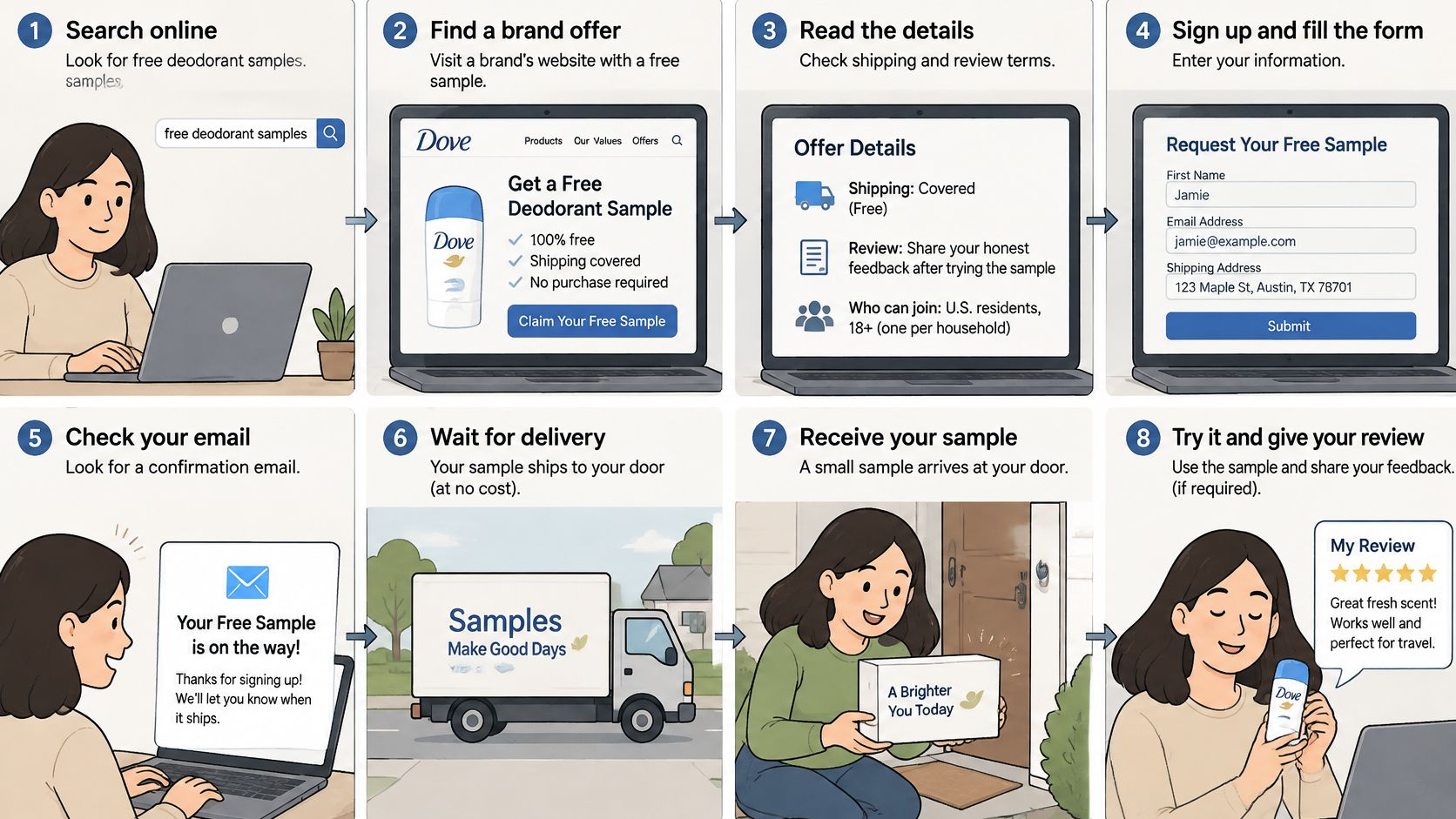
The path from sign-up to a published review is shorter than most shoppers expect. Here's the shape of it.
Where to look first
Brand pages and matching services that print the review terms up front are the easiest to vet. Skipped over are the newsletter pop-ups that promise a "free deo kit" and only mention a purchase minimum at checkout. If the terms are longer than the words on the product label, the terms are the thing being sold to you.
Here's the sequence, and the reason behind each step.
- Sign up and pick your categories. Testers sign up for free and choose the product categories they want to try, from skincare to pet treats. Choose categories you shop, because every product you accept carries a review you've promised to write.
- Read the offer sheet in full. Each offer names the product, its stated value, and the review deadline. Note all three before you decide, since the deadline is the detail that usually gets missed.
- Accept only what you'd use. A sample in a scent you'd never choose produces a review nobody can use, including you. Turning an offer down costs nothing and leaves the spot for someone who'll give it a fair test.
- Watch for the package. After you accept, the brand ships the product straight to you, so there's no code to redeem and no store pickup.
- Use it for the agreed period. Give it several mornings, one workout, and a hot afternoon before you write a word. First-day impressions on a deodorant are the least reliable ones you'll have.
- Post your honest review on the brand's own site before the deadline. Testers write for the brand's site rather than a marketplace, so the review lands on the product page where shoppers are already comparing.
- Keep the product and collect your points. Testers write an honest review and earn points for every on-time review, with extra points for qualifying photos, videos, and referrals.
Keep the points where they'll do the most good: spend them by applying for categories you buy, and let new offers come to you rather than chasing every one that appears.
Who Qualifies and How Brands Pick Testers
Two requirements come first. You need to be an adult, and you need a US shipping address. Everything else in matching is about fit rather than credentials, which is why a social media following isn't required.
Matching reads three signals: the categories you selected, the state you ship to, and the review format you prefer, whether that's writing, photography, or short videos. Brands also look at a tester's review history before they ship, so a pattern of on-time, specific reviews is the strongest thing you can build.
Audience fit isn't guesswork. In 2025, 5,501 UK students sampled Nivea Deodorant, and 84.0% said they were likely to buy it again while 95.2% said they would recommend it, according to Dig In. The campaign went to a defined group of likely buyers rather than a random crowd, which is the same logic behind category and state matching.
How the waitlist works
Testers join the waitlist for free, and SamplePact then matches them with brands that want someone like them. Some brands that pick their own testers ask a few quick questions on the application, and the brand sees those answers with your contact details hidden. Points affect selection priority, and the top twenty percent of testers receive a twenty-four-hour application window before other testers.
Picture three readers. A parent who selects baby products gets offers that fit a household with an infant, not a shelf of fragrances. A pet owner who selects pet treats sees campaigns for chews and grooming wipes. A shopper who prefers short videos over long written reviews gets matched with brands asking for exactly that format.
You're not limited to your matches. Testers can apply for products they weren't matched with, as long as the product has spots left, the brand ships to your state, and the brand asks for a review type you do.
Before you join, confirm three things: your shipping state, the categories you'll use, and the format you're willing to produce. The product tester page lays out the choices you'll be making.
Shipping, Timelines and What Happens If an Offer Closes
Money first, because it's the question everyone asks before anything else. The brand covers the shipping cost of each sample sent to a tester, so the product and its delivery are free on your side of the transaction.
Then comes the timeline, in the order a tester lives it.
From acceptance to published review
Say you accept an offer on a Tuesday morning. Brands must ship each sample within five business days after a tester accepts, so a tracking number should reach you before the following Tuesday. The review clock starts when the product is in your hands, not when you click accept, so use it for the agreed period and then publish by the deadline.
Now the exceptions. If a package goes missing, report it, and the report pauses the review expectation while the brand sorts it out. If the product turns out not to be one you want, a return is a legitimate alternative to reviewing it. You pay the return postage, and a qualifying return doesn't reduce your review score.
A brand can also end things from its side. When a brand presses Close this offer, the offer ends without a review, never counts against the tester, and frees the spot for someone else.
Report early, not late: a missing package that goes unreported looks exactly like a review you never wrote, and only one of those two things can be fixed.
These rules keep testers from being stuck with a product they can't judge and keep brands from waiting on a sample that never arrived. Your practical job is small: note the ship-by date when you accept, check for a shipment within five business days, and flag problems the day you notice them.
Disclosure, Honesty and Keeping the Product
The worry is fair, and the answer is yes. You can keep a free deodorant and still write a review saying it didn't work. Brands agree to publish every genuine review whatever the rating, and participation points depend on finishing on time and completing the agreed activities, not on a positive opinion or a star count.
Reviews appear on the participating brand's own website, usually on product pages, and never on Amazon or Google. Every review says the tester got the product free, so a shopper reading it knows exactly how the sample arrived.
What the disclosure rule asks for
The FTC's answers on the Consumer Reviews and Testimonials Rule state that a business may provide free product samples in exchange for reviews, but the resulting review must disclose that the reviewer received a free product. That applies whether the product was shipped directly, supplied through a code, purchased with reimbursement, or provided another way.
A disclosure doesn't need to be elaborate. One clear line does the work:
'I received this product free for testing; this review reflects my experience.'
Keep reviews to products you've tried. The point of the disclosure is that readers can weigh your words against the fact that the product cost you nothing, and that only works when the experience behind the review is real.
One mechanical detail catches testers out. Brands ship each sample using a shipping label rather than an order in their store, so the review app doesn't send its own automated review request. No reminder will arrive in your inbox, which means the deadline belongs on your own calendar the moment you accept.
What a useful review covers
Specifics beat adjectives. How long did the scent last, three hours or a full workday? How did the product feel on application, and did it leave residue on dark fabric? How did it hold up in heat, during exercise, or on a second application? A review that hides a free sample behind five vague stars helps nobody, least of all the next shopper deciding between two similar sticks.
Testing Deodorant Samples Safely on Your Skin
Start with the difference that decides everything else. Deodorant mainly controls odor. An antiperspirant uses aluminum salts to reduce wetness, and in the United States the FDA monograph permits aluminum chloride up to 15% in aqueous, non-aerosol products and aluminum chlorohydrate up to 25% (FDA OTC monograph for antiperspirant drug products). Judge an antiperspirant on wetness. Judge a deodorant on scent and odor control. Scoring them on the same scale is the most common mistake testers make.
A small sample deserves care here because a leave-on product sits on skin that rubs against clothing and sweats, so a reaction shows up fast and in a spot you can't hide. In a clinical provocation study, 12 of 20 deodorants, or 60%, elicited eczema in fragrance-sensitive participants, and reaction potential tracked allergen concentration rather than whether an allergen was present. A prior scented-deodorant rash also raises the risk of fragrance allergy by a factor of 2.4 (clinical provocation data on deodorant allergens).
Four steps keep a trial safe and useful.
- Read the full ingredient list first. Fragrance can appear only as 'fragrance' or 'perfume' on a panel, so the scent name on the front tells you very little about what's inside.
- Patch test on a less visible area. Apply a small amount to the inside of your forearm for a day or two before you put anything under your arm.
- Skip the post-shave application. Shaving leaves skin more reactive, and friction on a freshly shaved underarm turns mild tingling into something memorable.
- Stop at burning, itching, redness, or rash. Report it as a reaction rather than a low rating, because a reaction is product information and a star rating isn't.
| Deodorant type | What to test | Watch for |
|---|---|---|
| Fragrance deodorant | Scent strength and how long odor stays covered | Itching, redness, or burning |
| Fragrance-free deodorant | Odor control across a full day and skin comfort | Irritation from other ingredients |
| Antiperspirant with aluminum salts | Wetness reduction, residue on clothing, and reapplication needs | Stinging or irritation under the arm |
| Aluminum-free or natural deodorant | Odor control in heat or during exercise, and residue | Redness or rash after use |
If your skin reacts easily or you've had a reaction to a scented product before, stick with fragrance-free offers and read every panel first. The free skincare samples guide applies the same patch-test approach to other leave-on products.
Three Sample Scenarios and What Each Teaches
None of these are real testers. They're composite cases built to show how the same checklist plays out in different hands.
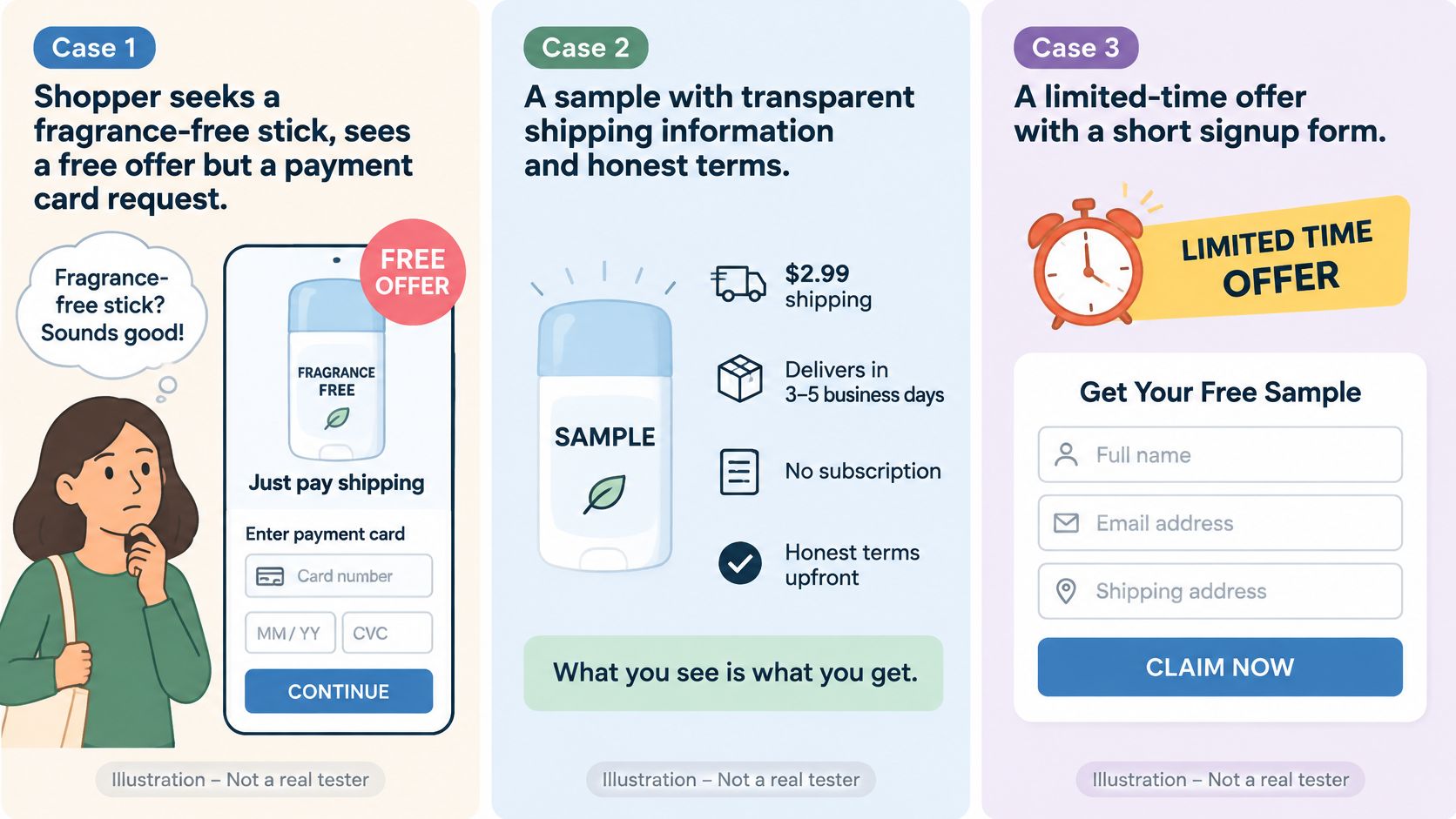
Case one, the card request. A shopper wants a fragrance-free stick and finds an offer with a free product, a shipping charge on top, and a payment card required to claim it. She reads the terms, pictures an automatic renewal she might forget, and passes. What she learned is that the card requirement was doing more work than the free stick was.
Case two, the stinging antiperspirant. A reader with sensitive skin receives an antiperspirant, notices stinging after the first full day, and stops. She writes an honest review that describes when the stinging started and how long it lasted. The brand gets evidence it can act on, and the next shopper with reactive skin gets a warning that applies to them.
Case three, the offer that closes. A parent applies for a baby product and the brand closes the offer before shipping. The offer ends without a review, nothing counts against the parent, and the spot opens for another tester. The lesson is that a closed offer is an administrative event, not a strike on your record.
The thread that connects them
Each case turns on the same habit: read the terms before accepting, then report what happened. One reader saved herself a recurring charge, one gave a brand useful safety feedback, and one lost nothing at all when a campaign ended early. The product changes in every scenario. The checklist doesn't.
Confirm the Terms and Join the Waitlist
Joining SamplePact as a tester is free, and the products and shipping are free too. Categories include skincare, makeup, perfume, pet and baby products. SamplePact currently runs a waitlist and early-access stage, so joining now secures your place in line.
Five things to do before you accept anything.
- Pick categories you'd really use. A fragrance sample is wasted on someone who never wears scent, and a pet treat is wasted on a household without a dog.
- Confirm your eligibility. You need to be an adult with a US shipping address, and the state you ship to determines which offers can reach you.
- Choose the review format you'll produce. Writing, photos, or short videos, picked with realism rather than aspiration.
- Run the seven-term checklist on each offer. Product cost, shipping, card, purchase requirement, review expectation, keep-or-return, and expiry.
- Calendar the deadline the moment you accept. No automated reminder will arrive, so the calendar entry is the reminder.
Start at the SamplePact join page and you'll finish with something concrete: a way to find free deodorant samples, a checklist that keeps the terms honest, and a next step you can take today.
SamplePact matches US adults with brands that send free products in exchange for an honest review published on the brand's own website, and testers keep the product after reviewing it on time. If a deodorant sample lands on your doorstep, you decide what the review says, and nobody asks you to soften it. Join the waitlist at SamplePact and choose the categories you'd use.
SamplePact
Get free products to try
Brands send you new products for free, and your honest review goes on their own website. It's free to join, and the products and shipping are free too!
- UGC creators5 min readWhat Is a UGC Creator?What the term means, how UGC differs from influencer work, how to get started and how disclosure works.
- Free samples4 min readHow to Get Free Samples on TikTokHow TikTok Shop's free samples work for creators, from who qualifies to the 14-day posting rule.
- Product testing4 min readHow to Become an Amazon Product TesterHow Amazon Vine invitations work, what Vine Voices get, and Amazon's rules on free products for reviews.